Dierdre Shea & Julian Goldman
A Building is a Hypothesis
It was winter in 2022, and our first child was on the way. Every evening on our way home from our rented studio, we passed the vacant “Testo’s Kitchen” building on Jefferson Street. It was a relic of Troy’s industrial peak in the 1800s, an umber-colored brick hulk with a peeling garage door and a large storefront display.
Six tall windows marched across its second story facade. Ivy, wild grapes, and bittersweet blanketed its rear exterior. A handsome tin cornice crowned it with florets. The building had become a continual subject in our discussions: What if we bought it and turned it into our design studio?





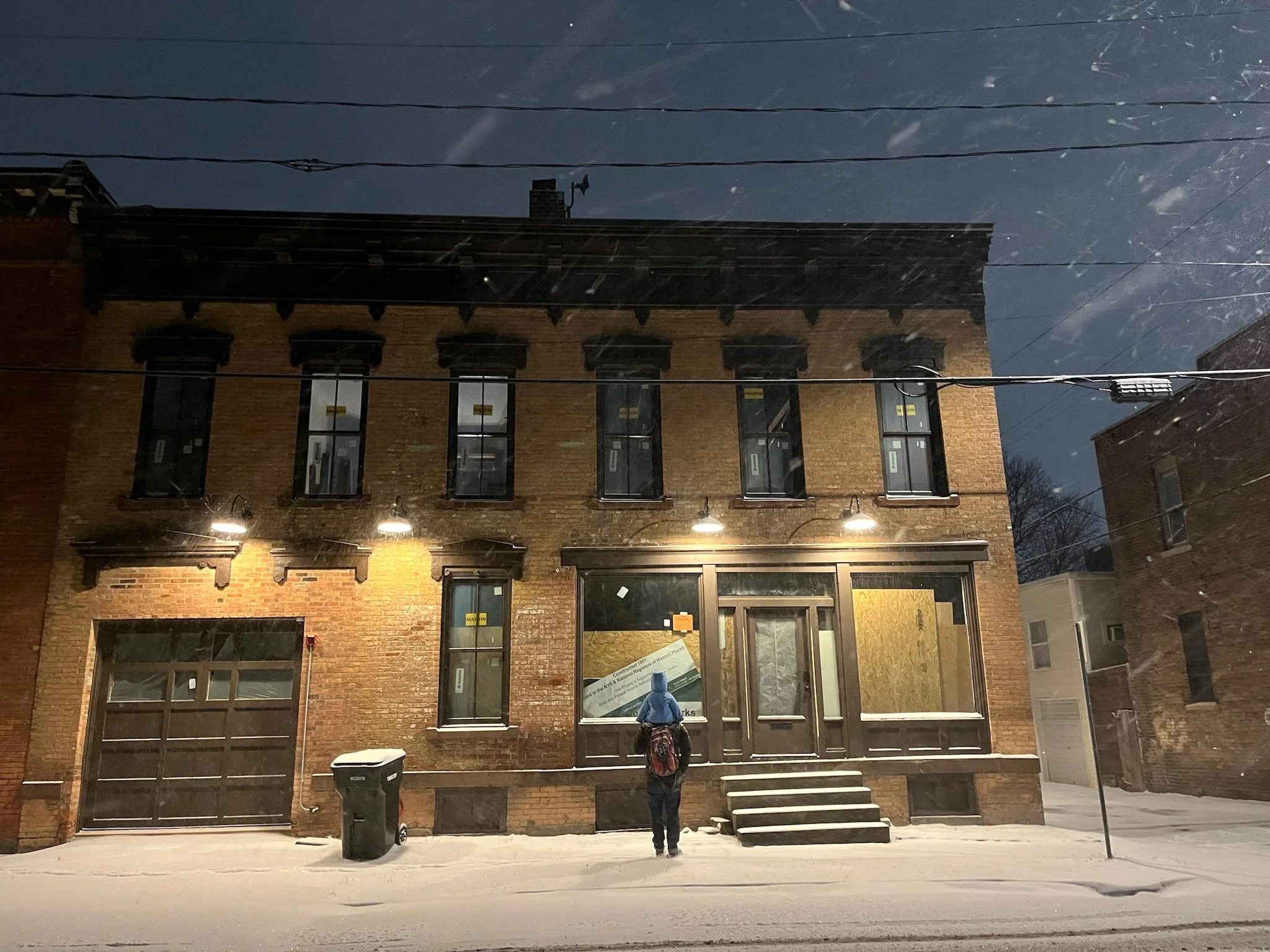
One morning approaching the familiar silhouette, we cupped our hands to its plate glass window and glimpsed into a dim shipwreck of rotting mattresses and dusty linoleum countertops. Beyond the forgotten clutter, the building’s brick envelope looked intact. Steel I-beams held it sturdy. It has good bones, we thought, ignoring the missing windows. And the single bullet hole.
That night, a few months from our due-date with Dierdre’s swollen belly pressed up against the kitchen table, we prepared dumplings for Chinese New Year and debated the dream of owning Testo’s: We would have enough space for a CNC milling machine and a kiln… Our friends and colleagues could visit and work with us. Maybe we could build a loft where they could sleep… A little kitchenette would be so nice. We could host dinners.
Buying a building isn’t just acquiring walls and windows, it’s buying a dream, the potential for what could happen in that space. A building is a hypothesis. Bricks and concrete give heft to a vision still forming. That spring, with a three-month-old strapped to Dierdre’s chest, we did our first walkthrough.
Testo’s was more battered than we had originally thought. The concrete floor was crumbling, exposing the rebar. And after a century of rainstorms blowing in from the Hudson, the sandstone windowsills had worn away. There were no stairs to the second floor, just a ladder.
How much would this cost? How were we going to pay for it? Do we even have time for a project like this? Encouraged by our design studio’s early success and the urgency of a growing family, we stopped hesitating. The challenge of renovating Testo’s would require manual reconstruction (to meet the regulations of a historic site), but also the more heady labor of imagining what would happen when we finally finished restoring the building.
As industrial designers, this type of imagining is fundamental to our practice. The two of us specialize in materials and climate innovation—biomaterials, waste materials, materials distilled from captured carbon. These technologies require a kind of dreaming because the technologies aren’t always mature. They require an imagination for what could be.
Dreaming has always been fundamental to our relationship. When we first started dating as students at Pratt, Julian had taken us to CW Pencil Enterprise, a novelty shop on the Lower East Side that sold every imaginable pencil (not a single pen). While poking through glass jars of Blackwings, we started talking about the Artist’s Way, which led to a conversation about how a pencil might measure one’s “daily writings.” How much lead would a person need for a 20 minute writing exercise?
By the time we had gotten off the train at Bedford-Nostrand, we had three different designs sketched. By the end of dinner, we had decided that the right tool was a pen and calculated the number of miles a Bic ballpoint could write if the streets were made of paper. The answer: two miles.
Like two students falling in love for the first time—our younger selves just beginning to know each other—the building offered a glimpse into another way we could exist in the world. We had come together as young single people; now we were a family. Testo’s could be an extension of that transformation. It could be a sanctuary, a creative nest, not just for us, but for the community of artists and designers who we were beginning to meet in our new city.
In one daydream, a neighbor would come and use our equipment to fabricate an outdoor kiosk for the local trailhead. In another, a group of architects, artists, and kids would come together to build robots from off-the-shelf electronics and then teach others by publishing a manual. We pictured clients spending afternoons spitballing ideas. For us, Testo’s could become our space for bringing reality to dreams.
We recruited Dierdre’s mom, a retired architect, and her dad, a former city planner to help us. Dierdre’s mom drew the plans by hand. The entire first floor would be our “messy studio space,” the place for the equipment we had collected, foraged from old jobs (an industrial braiding machine), handed down from mentors (a ceramic kiln), and salvaged from university trash piles (a Bridgeport mill).
The second floor would be our office and a shared studio. From there, the floor’s 15 windows would offer a panorama of Troy—the flat rooftops to the south, the industrial architecture of our neighborhood, the treelined hills to the east, and the changing seasons all around.
As designers, we assumed we could manage the job. But in the months of work that followed, failures besieged us. The rotting columns at the front door required us to rebuild the entire storefront facade. After we installed HVAC ducts, we had to install new ones after we accidentally filled them with construction dust. We commissioned period accurate, hand-crafted doors that had to be repaired when they leaked and became mottled from rainwater. The worst was when we had to refinish the second story floors a second time.
There is a distinct physical punch that comes with this kind of failure. Our 18 month timeline stretched into three years. Each time we hit a snag, we had to revisit the dream. What are we doing again? It was surprisingly easy to lose clarity, a clarity that we pride ourselves on with our clients.
Meanwhile, our daily lives bore their own struggles. A heartbreaking pregnancy loss stopped everything for a time. There was the hopeful creation and sad dissolution of a creative collective. There were 24 months of sleepless nights soothing our first baby, and many more to follow with our second. Julian revised Gantt charts, worried over budgets, while Dierdre wrote work proposals from bed. Simultaneously, the economy soured on sustainability companies. The setbacks fed a continual dribble of doubt. What are we doing? Did we trap ourselves in a bad decision? We steadied each other in moments of panic, Step back, take an even longer view.
Small wins buoyed us—3D printing missing pieces of historic trim, the gorgeous wood floors cleaned to reveal a century of machine oil stains, the glass panes we installed in the rear deck.
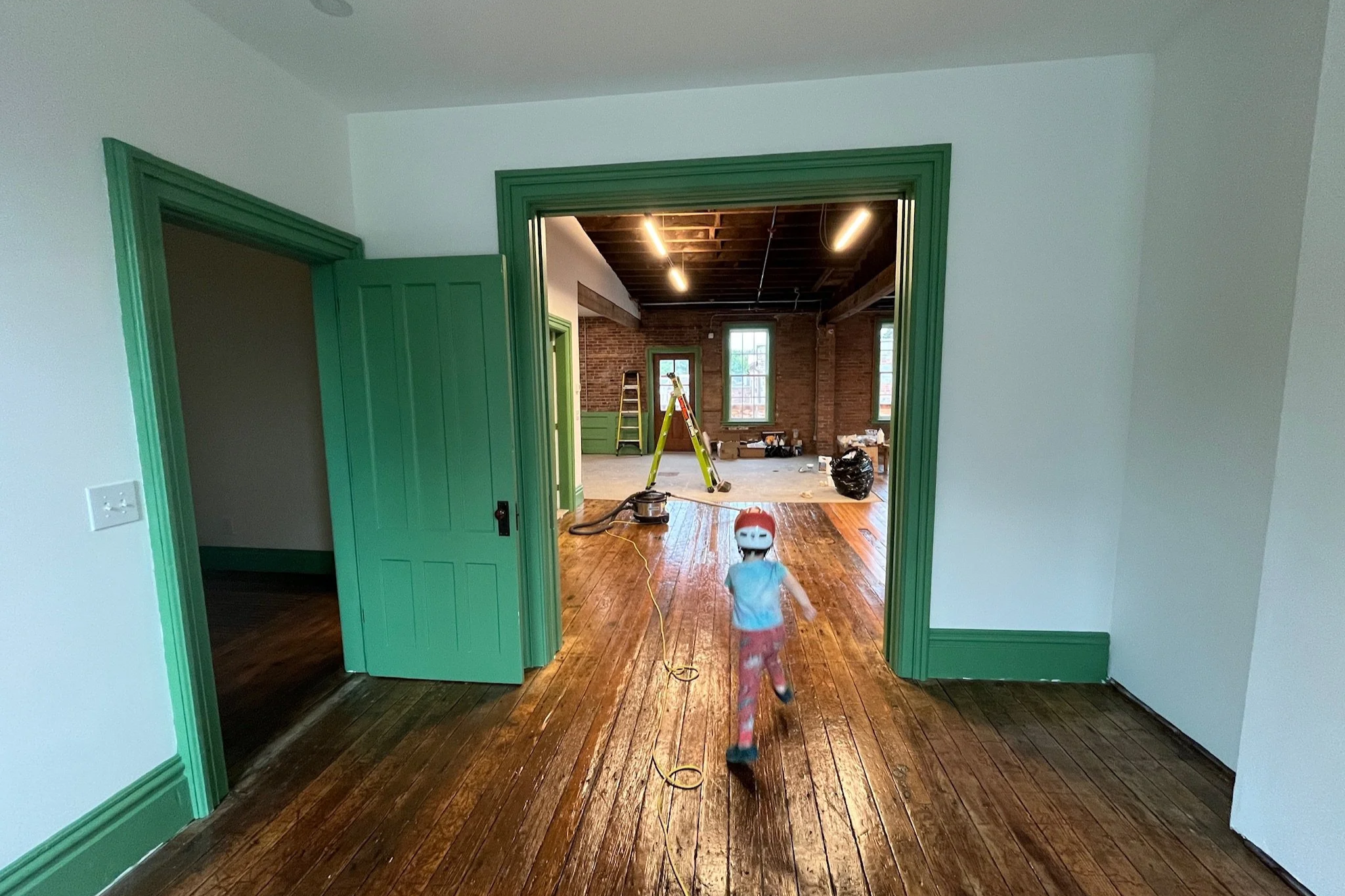
This November, we finally started moving in. The last messy construction projects were finished and the floors were sealed. We brought a carload of plants first. There was no furniture to put it on, but the greenery caught the southern sunlight and brightened our spirits as we started to measure plywood panels for desks. Outside the windows thick snow flakes swirled. We laid out the office space and sat down to start client work.
Sometimes during our morning walks to Testo’s, we talk about projects we want to do, a few years from now, sometimes five, even ten. We see a space for flow states and deep intention, a space to make mistakes, to play and make things, to break things and laugh. A place to learn. Today, as we write these words, our three-year-old is running around taping bits of found materials to the wall.
“Come look at my sculptures,” he says. The building is already starting to do its work on him. We set up his “office” overlooking the front window, with a chair for his brother to join him, he says, “when he’s big enough.”
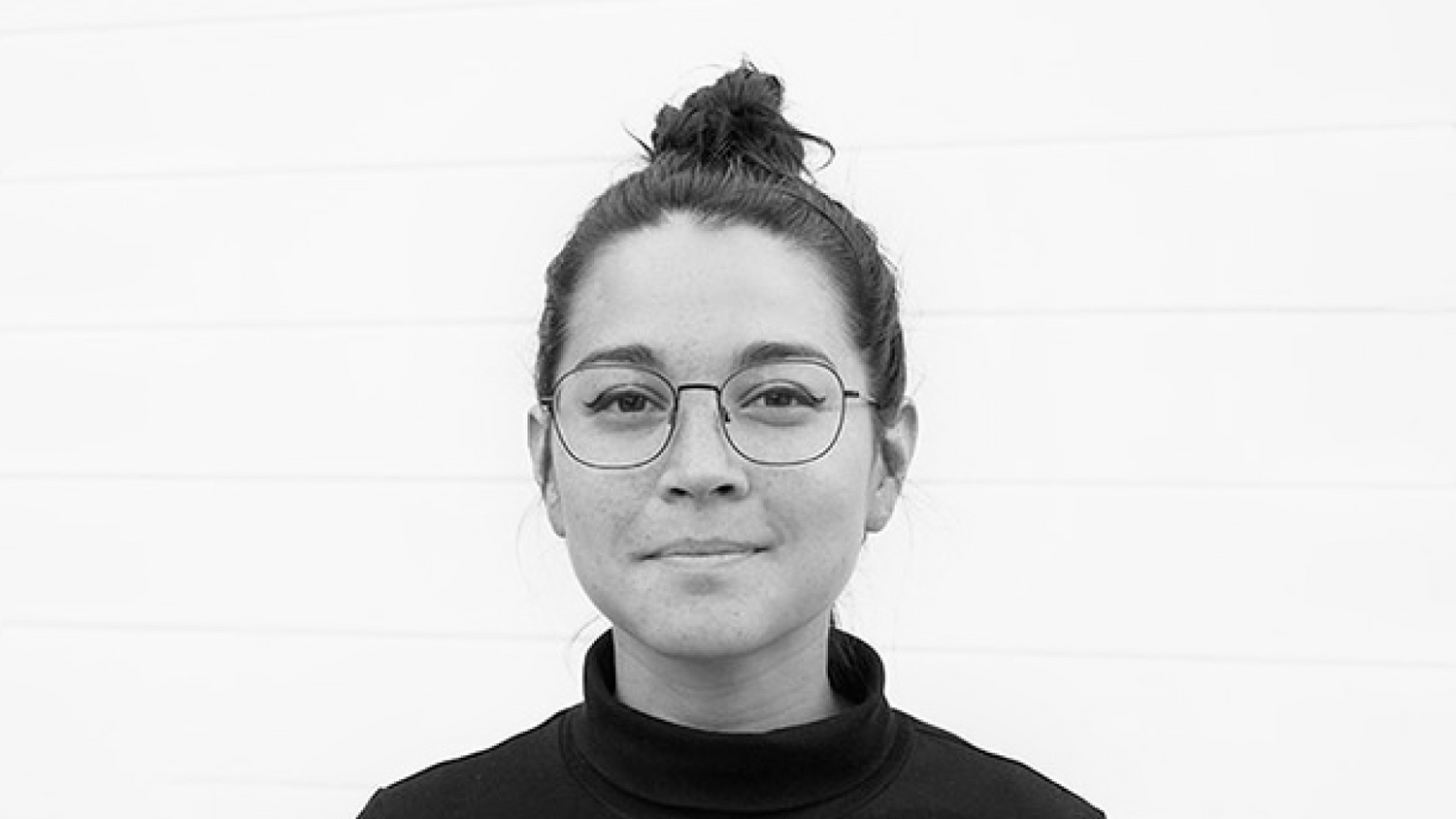
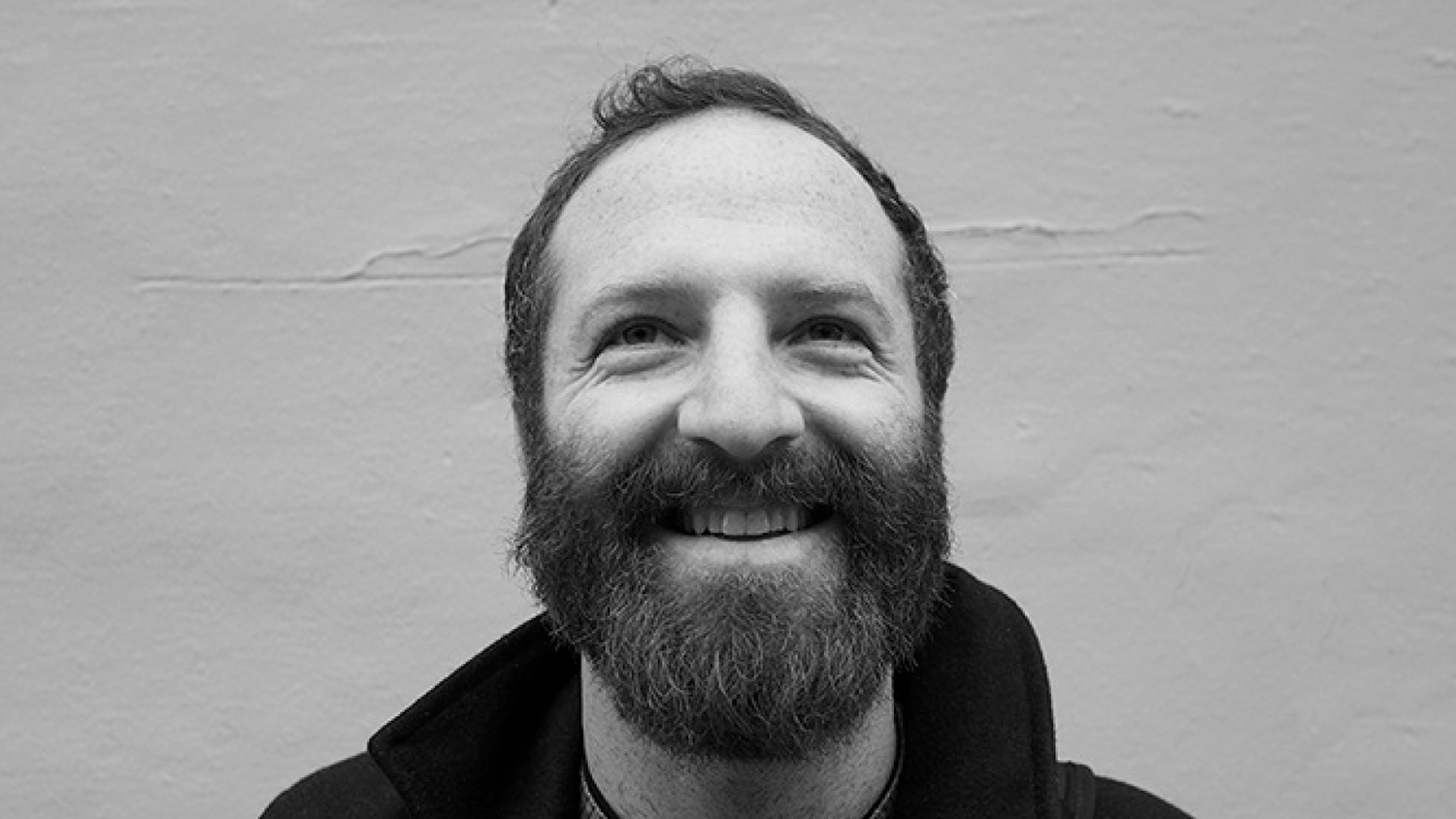
Dierdre Shea & Julian Goldman
Dierdre is an object designer with a background in ceramics, industrial design, and manufacturing. Her work centers on developing meaningful relationships between humans, ecosystems, and products with the goal of reform systems of mass production and material consumption.
Julian is a designer and artist focused on the points where novel technologies and materials touch society. He has worked for a variety of clients designing everything from space suits and fishing gear to wearable knit sensors and fashion accessories.
The two are cofounders of Fun Stuff Design, an industrial design studio that specializes in sustainable product and materials development with a focus on biomaterials, climate tech, and objects with meaningful life cycles.