Karen Ingram
Still Life, Never Still
It’s August and another humid day in Rockaway Beach—I’m grateful for the ocean breeze. I’m in my bungalow sitting at my kitchen table bent over a Petri dish. The sweet aroma of the agar makes me crave doughnuts. The Petri dish is sweating, and I’m sweating. My oversized glasses are sliding down my nose. I’d prefer to not paint on such a hot day but I have a deadline. I need to get three Petri dish paintings into the incubator for an upcoming show.
I’ve made the preliminary drawings in pencil, plotted out the places where I’ll dot the colors, and now all I have to do is make the marks with the yeast. I do my best to wait until the condensation has disappeared from the dish. I select a dazzling shade of magenta by tapping a toothpick onto a palette with fourteen different dots of yeast, each a different color. I make slow, deliberate lightly etched marks into the agar, referencing my preliminary study. As I draw very lightly, I am reminded of the words of a painting professor in college. “Intentional strokes. Each mark has a purpose.” This is more true for agar art than for oil paint. With oil paint you can scrape away the errors with a palette knife. With agar art, you are seeding the painting. Once the microbe meets the media, it’s going to grow there. At least, that’s the expectation.







When I’m finished, I put the dish in the incubator. It’s a picture of an orchid, but I can’t see it yet. The image will grow over the next four days. The heat and humidity will probably expedite things a bit. This is the last of the petri dishes. I’m ready for a break. I have two hours before I have to get back home to photograph them. My plan is to make a stop-motion animation of the dishes as they grow. I don’t have control of the lighting in my bungalow, so my remedy is to take as many photos as possible. Later, I will stitch them together into a video that will chronicle the growth of the microbes.
Rockaway may be on the outskirts of New York City but it has the vibe of a small town. I hop on my bike and ride to the boardwalk. At the corner of a row of bungalows, I pass Colleen. Her uniform is Uggs, a plaid flannel shirt, and a backwards baseball cap. ”Hi Colleen” I sing, as I maneuver along the narrow path. I wave to Pat as she tends to her garden. Her vines of cucumbers and tomatoes are poking through the chainlink fence. On the boardwalk, I weave through the DFDs staggering like burnt beach zombies. DFD, “Down for the Day,” is the term locals in Rockaway use for folks coming in for the day from Brooklyn and Manhattan. The DFDs pour out of the subways like children off of a school bus starting at 10am.
After some sunshine and air, I head back home. Before moving out to Rockaway, I used to be a creative director for an ad agency. But over the years I found myself drifting away, finding myself drawn to creative projects with technical or scientific facets. Eventually, I traded my markers, acrylic paint, and Waycom tablet for living art.
My bungalow is basically one room. My lab bench is a stretch of countertop next to the microwave. A few months ago, my friend Jennie had helped me move in a liquid handling robot. The robot is a two-foot cube perched on a stainless steel food prep table. It’s a decommissioned COVID testing robot complete with a biohazard sticker and googly eyes placed no doubt by the scientist doing the testing. I find the personification charming. The brand name, “Opentrons,” was applied with a sticker, and the “t” is peeling off. I named the robot “Ron,” having decided that the robot basically named itself.
No longer a homey surf shack, no longer a shrine to salt and sand, my little beach bungalow has become a lab. Along with the robot, I have several incubators and lab tools. Open my fridge and you’ll find that a third of it is dedicated to bioart. A sticky note reads, ”No Food Please!" with a heart flanked by two wispy E.coli doodles. These are the shelves that host my microbes. The message is more of a joke to myself, but others find it funny too. I once hosted Rebecca, a college friend and successful writer, for a beach weekend. Upon looking in my refrigerator, she laughed. “I don’t want to eat science jello for breakfast.” Ever since then, I’ve adopted the phrase “science jello”—it makes my media feel more familiar.
“The next pandemic is coming out of your bungalow,” Nikolay jokes. I laugh, but in the back of my brain, there’s a little twinge. Not because that could be true. Because of perception. It isn’t biologically possible for me to engineer a pathogen with my materials and skills, but I know people can get carried away when introduced to something they don’t understand. Sometimes perception is dangerous enough. Fear takes hold, and that’s that.
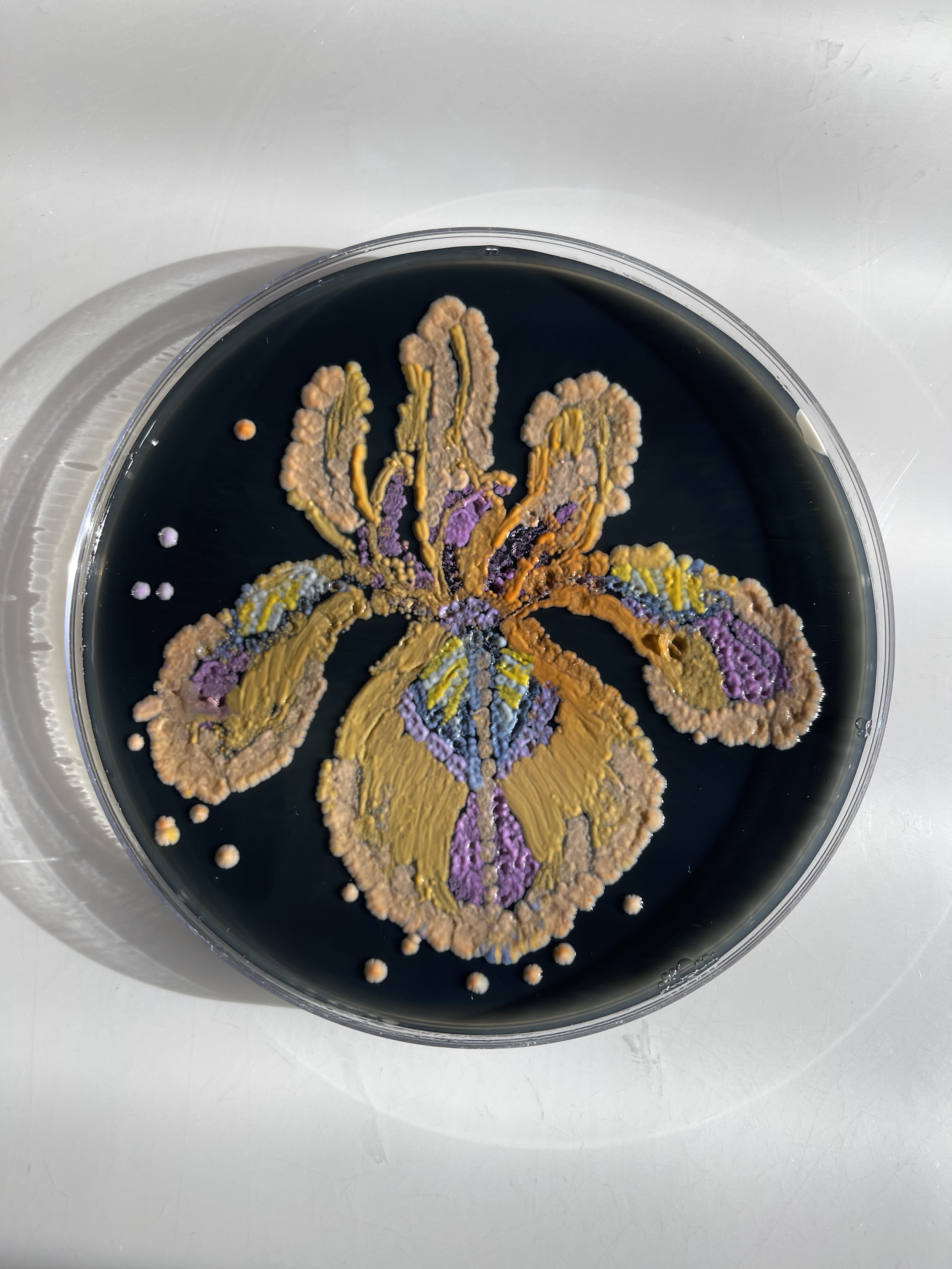
I like to think of the flipside of fear as wonder, which can be just as powerful. “What are you doing with all that biology stuff?” they ask. It’s a hard question for me. “I’m exploring,” I say, exploring a new canon for creativity. Alongside line, texture, shape, and form, I am exploring light, growth, temperature, time, compatibility, contamination and all the factors that influence a microbial ecosystem. These factors alter my image. My friend Leslie—always the problem solver—says, “You are inventing a new art form,” though I know I’m not the first to make microbial art. That title might go to Alexander Fleming, who invented modern antibiotics with a soil bacteria called Penicillium. Fleming, was also an amateur watercolorist and painted figurative paintings with the spectrum of colorful microbes he collected for his research. Today, microbial painting is done as a form of science outreach. It is not explored as a language of art.
I see what I do as more of an extension of printmaking. Printmaking runs in my family. My aunt made woodcuts, and I tried printmaking, etching, drypoint, and linoleum block prints in school. Microbes remind me of those other mediums. Aquatint etching requires you to paint layers of resist over a zinc plate speckled with resin, dipping the plate into acid with each layer of resist to create the shading in an image. With etching, acid makes the image by eating into the plate. With microbial painting, the image grows. Every brushtip contains an invisible panoply of life. Each tap flourishes into a burst of color. I plant, seed, arrange the image, and the microbes render it. Microbes, however, don’t behave predictably.
Early on when I was learning how to surf, it was like having a crush, an initial hyperactive buzz. Then, lucidity kicked in. I grappled with the anxiety and the knowledge that I was unskilled. I’d fall in the whitewater, get tossed around in the chop, and once caught a current so strong that I drifted into a rock jetty. After the initial excitement, there was an “and now what?” moment that took a while to get over. If I was in the water, and realized the waves were too big and choppy, I’d get scared. I gripped the board too tightly, braced myself, and looked down at my board as a wave crashed at my back. I’d go flying. Board flying, me flying, pure chaos. “Why do I want to do this? Do I want to do this?” I’d ask myself.
But I did want to do it. There’s a humility required to be an adult learner. I experienced this with surfing, and now with biology. It took years for me to get past monochromatic doodles to the rich, painted works in yeast that I now make. It took time for me to even see painting with microbes as an extension of painting. I love seeing the images I planted begin to materialize.
Winter in the Rockaways is a great time to incubate new things. It’s very quiet, and the wind blasts from the sea, making ghostly noises between the bungalows. Every fall, there are promises between friends for weekly dinner parties. The reality is, once winter sets in, people tend to leave or dive into personal projects. There may be a stray dinner party here or there, but mostly it’s a time for seeding new things. My friend Riva who I surf with told me, “In the winter, it gets quiet.” she said. “It’s always good to have a project going.”
Ron is my project. After many clumsy mishaps, I managed to develop a methodology. I create the design of my petri dish paintings first as a bit map, convert it into code, and upload it to the robot. I first print the designs with food coloring on paper. Once I’m happy with the design, I try it with liquid cultures of microbes on agar. I have to be careful that the robotic pipette-tip is positioned properly. Otherwise, it will stab and streak the agar, or miss it entirely, releasing giant blotches of yeast. Some of these errors can yield interesting results. Sometimes they’re like 8-bit Space Invaders and sometimes they’re like puddles of watercolor. I’ve come to plan for the variances.
On a chilly February Saturday, I stage my methodology with Ron as a painting performance before a gallery audience in Brooklyn. Droplets bud from the pipette tips, then leave beads of yeast along the surface of the agar. The spectators watch the robot arm move around the deck. Some come close with their phones to film the whirring machine. Some ask questions. Ron paints several flowers, lightly dragging the pipette tip on the agar in a motion that a scientist might call streaking, but to me, is painting.
Several days later, flowers emerge in bright bursts of color. Orchids, poppies, daffodils, irises, tulips, columbine, and venus flytraps all formed by microbes doing what they do—growing, dividing, just living their lives.
Karen Ingram
Karen Ingram is an interdisciplinary artist and researcher who works across bioart, biodesign, and biotechnology. Her work has been exhibited at BioBAT Art Space, London Design Week, Times Square, and Plexus Projects, and covered in Nature Biotechnology and Art Spiel. A former Emerging Tech Fellow at Stanford's d.school and NYFA Queens New Work grant recipient, she is co-author of BioBuilder: Synthetic Biology in the Lab. She has taught at SVA, NYU, and Genspace. In 2025, Ingram founded BioArt Studio at Makerspace Charlotte where her workshops engage audiences with biology, art, and technology through curiosity-inspiring activities.