Shanice Otersen
On Building Something You Cannot Keep
I fell in love with biodesign during my master’s studies at the Kolding School of Design in a small city in the south of Denmark. Originally from Germany and educated as a fashion designer, I had come to study sustainable design, but every morning when I woke up to work on my thesis, I felt like my lungs were tied down. Biodesign allowed me to breathe again.
I had come across the field in my coursework. While I was always interested in the arts, I struggled to keep up in science. Biodesign offered a meeting of the two that felt meaningful and real, like I could access it. I absorbed everything I could. I idolized its champions—Neri Oxman, Natsai Chieza, and Suzanne Lee. It bled into my projects. But with limited lab tools, I humbly made rudimentary biomaterials from gelatin, agar, and corn starch, or kombucha and mycelium kits.
When I graduated, the field of biodesign was still so small, there was no work. I landed back in fashion as a print designer for an underwear and socks company. Sure, it was fun, but there are only so many floral underwear patterns you can design before boredom sets in. One day, a former classmate told me that a fabrication lab in the nearby city of Vejle was looking for a biodesign volunteer. I was on the train a few days later, looking over the expanse of the fjord at the entrance of the city.
Vejle's Fablab was housed inside Spinderihallerne — the Spinning Halls — the last surviving cotton mill from the era when Vejle was called the Manchester of Denmark. The mill had closed at the turn of the millennium. Now it was a cultural house: bright, lofty rooms transformed into a café, artist studios, a roller skating rink, a wine and vinyl club, and Vejle's Department of Innovation and Entrepreneurship.
The Fablab was unmistakable for its smell—burnt plywood, melted acrylic, and PET. Heavy tools and machinery lined the walls. 3D-printed knicknacks cluttered the tabletops. There I met the lab director, Peter, a short, funny guy with a 90s aesthetic and long thinning hair flying behind him. He said that he wanted to push the Fablab beyond plastics and acrylics into something more sustainable, something biobased, and he needed a volunteer to lead the exploration. Once a week, I took the train to Vejle, set up kombucha brews, worked with mycelium, and created a slowly growing biomaterials library.
Within a few months, Peter told me that Novo Nordisk had awarded a grant to install a biology lab at the Fablab to teach high school students after school. He asked me to apply as the project lead. I doubted I was capable. Surely, they would find someone more qualified, someone with a biology background. But after deliberating for two weeks, I knew I had to try. When Peter finally called with the offer, I was so happy, I did not know where to put my energy. I went for my usual walk in a meadow behind my house, but ended up running down the path, spinning around, until I spun so much, I fell into the nettles. This is how I ended up in Vejle at the Fablab.








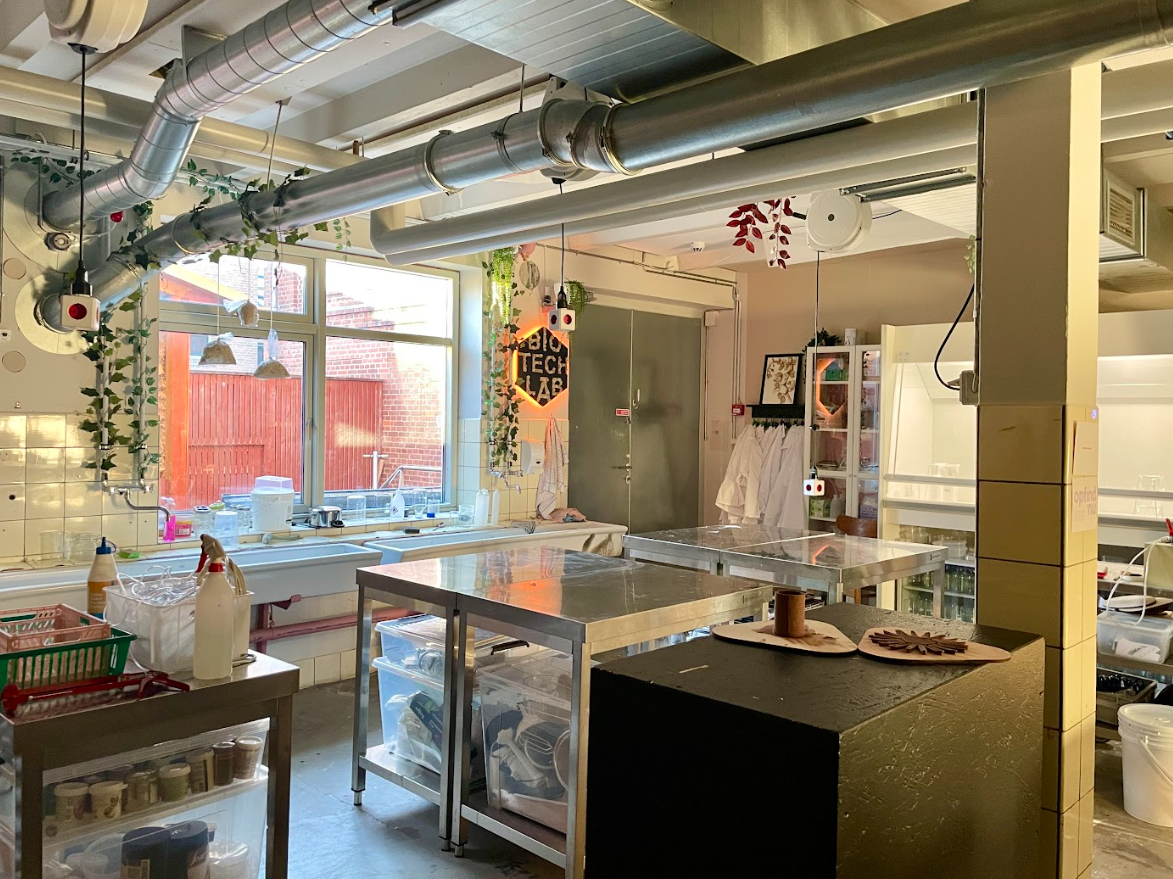
On my first day, Peter introduced me to the space that would become the biolab. It was empty except for two long wooden tables and a storeroom filled to the ceiling with cardboard boxes. This would become my domain.
Peter also introduced me to my colleagues, who were the best kind of nerds: Johannes, the kindest and most patient coworker, spent even his free time at the Lab, 3D printing Star Wars action figures. “Master Joda,” we called him. Lars had the rare quality of making people feel seen and valued; we called him “Seagull” because he always ate our leftovers at lunch. Simon liked order—his desk was the only organized one. Meanwhile, Peter seemed to keep half his household on top of his. Even though my job description was solitary, I was glad for their support.
In the beginning, I wanted to map everything out, set budgets, and mark every piece of equipment and its location. My colleagues had the attitude that things would sort themselves out. In contrast, my anxiety never let up. The whole project hinged on teaching students biodesign, creating workshops, and engaging with high schools and teachers. Considering that I had only three years to achieve these goals, I felt like I had to get the lab off the ground within the first six months. It was overwhelming, and I had no idea where to start.
I ordered and cultivated bacteria: Spirulina platensis (for harvesting pigments), Komagataeibacter xylinus (for growing leather-like materials), Janthinobacterium Lividum (for dyeing fabrics), and mycelium (for growing materials). I felt like the caretaker of a strange garden, a garden filled with material swatches, the acid stink of kombucha brews, the sound of bubbling tanks of spirulina, and, for a short while, the soft glow of bioluminescent bacteria.
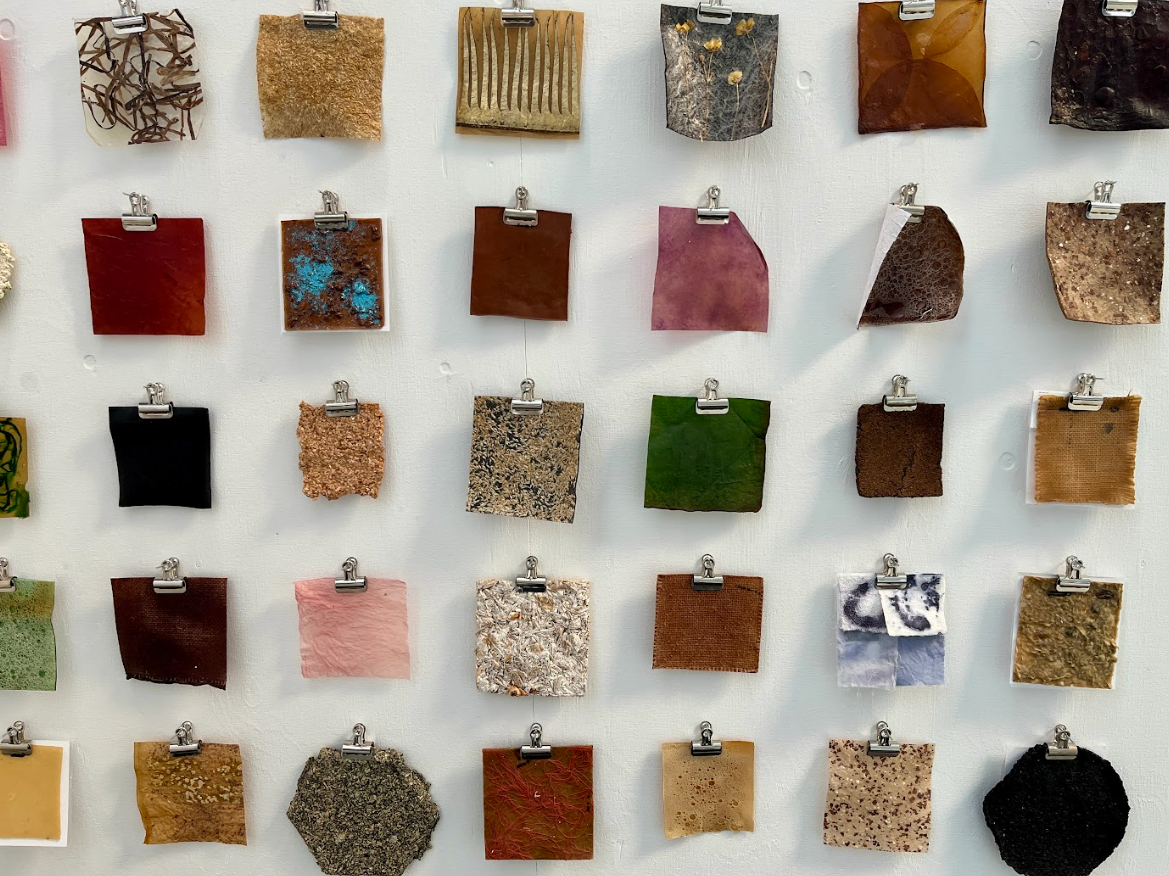
I was not always a good caretaker. After a few weeks, the photobacteria decided never to glow again. Failure was part of the process, but it never diminished the excitement and joy. Quite the opposite—the struggle made it worth it. I loved coming in the morning and observing whether my small experiments had worked. Yes—adding cabbage leaves to kombucha turns the material pink and then neon blue as the PH rises. Yes—feeding spirulina to other bacteria stimulates massive colony growth. These experiments were the best part of the job. The scariest part was the classroom.
Novo Nordisk had funded the project to provide an alternative learning environment for high school students. As an introvert whose voice breaks when she speaks up, I was mortified to stand before large groups of judgemental teens. Though most were incredibly kind and supportive, I had to suffer through questions like, “Who is paying for this?” or “Is this really a viable business?”
Eventually, I learned to tailor my workshops to supplement classes at the three nearby high schools. For one biology teacher, I shifted the focus of my mycelium workshop from simply growing materials to a broader understanding of the lifecycle of fungi and how to cultivate them in different substrates. For another teacher at a vocational school, I created a course on innovation and sustainability. Everyone told me that teaching would get easier, that the anxiety in my chest would ease. It never did. It was constant, always sitting right next to me. It just became a thing to accept. The need to turn the lab into a success was stronger than my discomfort.
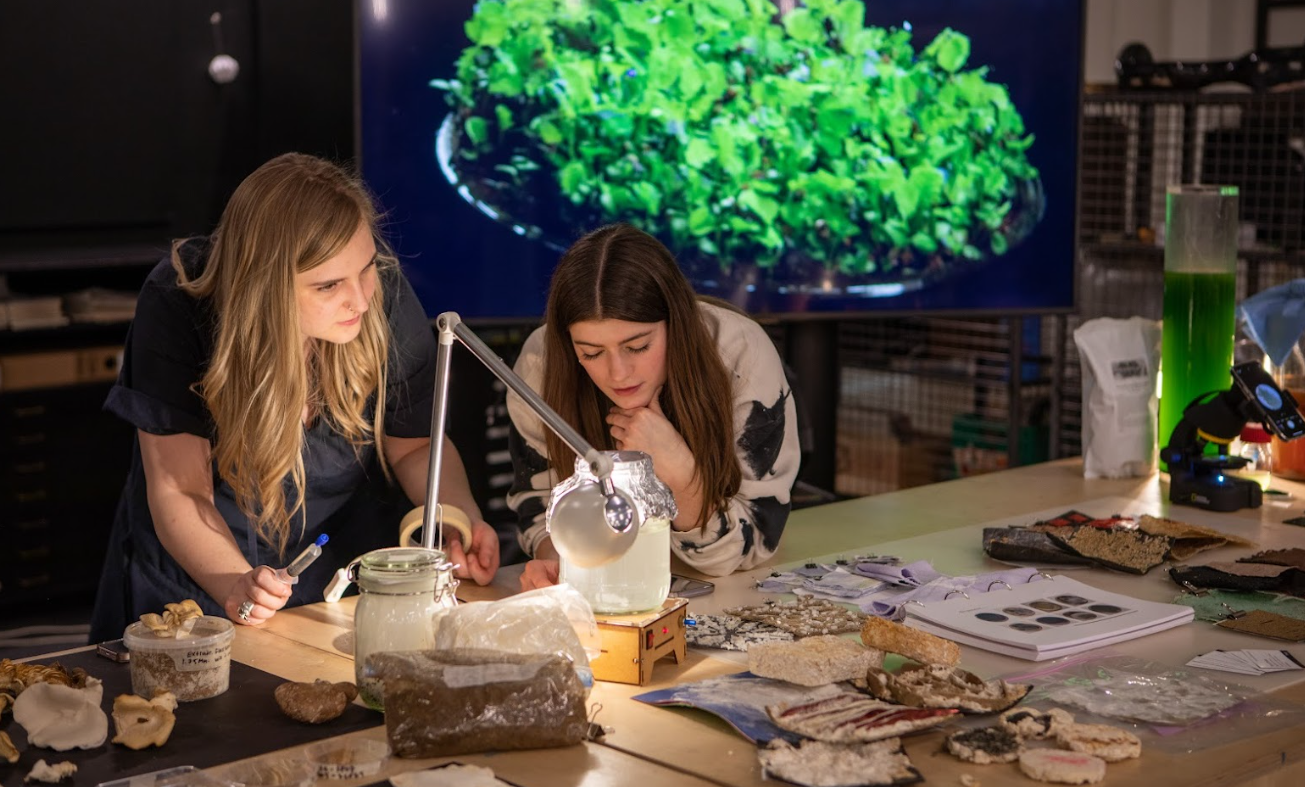
Thursday afternoons, I opened the lab for people to wander in with questions or projects. At first, no one showed up, and I used the empty hours to brew materials and rehearse strategies for attracting students. Then one afternoon a woman with long blonde curly hair showed up at the door. "I saw what you're working on," she said. "I'm Sanne. I volunteer here sometimes." She paused, almost shyly. "I know this space is for students. But could an old lady also come during open hours?" Sanne, a freelance fashion designer with over 20 years of experience, turned out to be extremely supportive, helped film workshops, and took pictures of our projects for social media.
Not long after, Eva the art curator brought in a short dark-haired woman named Emanuela, a researcher interested in art and science, who spoke so quickly and with such intensity that I caught only every other sentence. Within an hour we had decided to collaborate. I gave her the natural pigments I had brewed in the lab. She turned them into watercolors. Weeks later, she came back reporting that the turmeric was a “bastard,” but she had learned to control it, and that her husband, a programmer and associate professor, wanted to join too.
Soon the lab was no longer empty. Emanuela and her husband Andrea were 3D printing clay, Sanne was pressing bioplastic sheets, and university students were working on biodesign projects. This was an environment where high school students could join conversations, swap ideas, and contribute to projects. When a high school student arrived with a question I couldn't answer, I no longer had to go searching alone. The room answered.
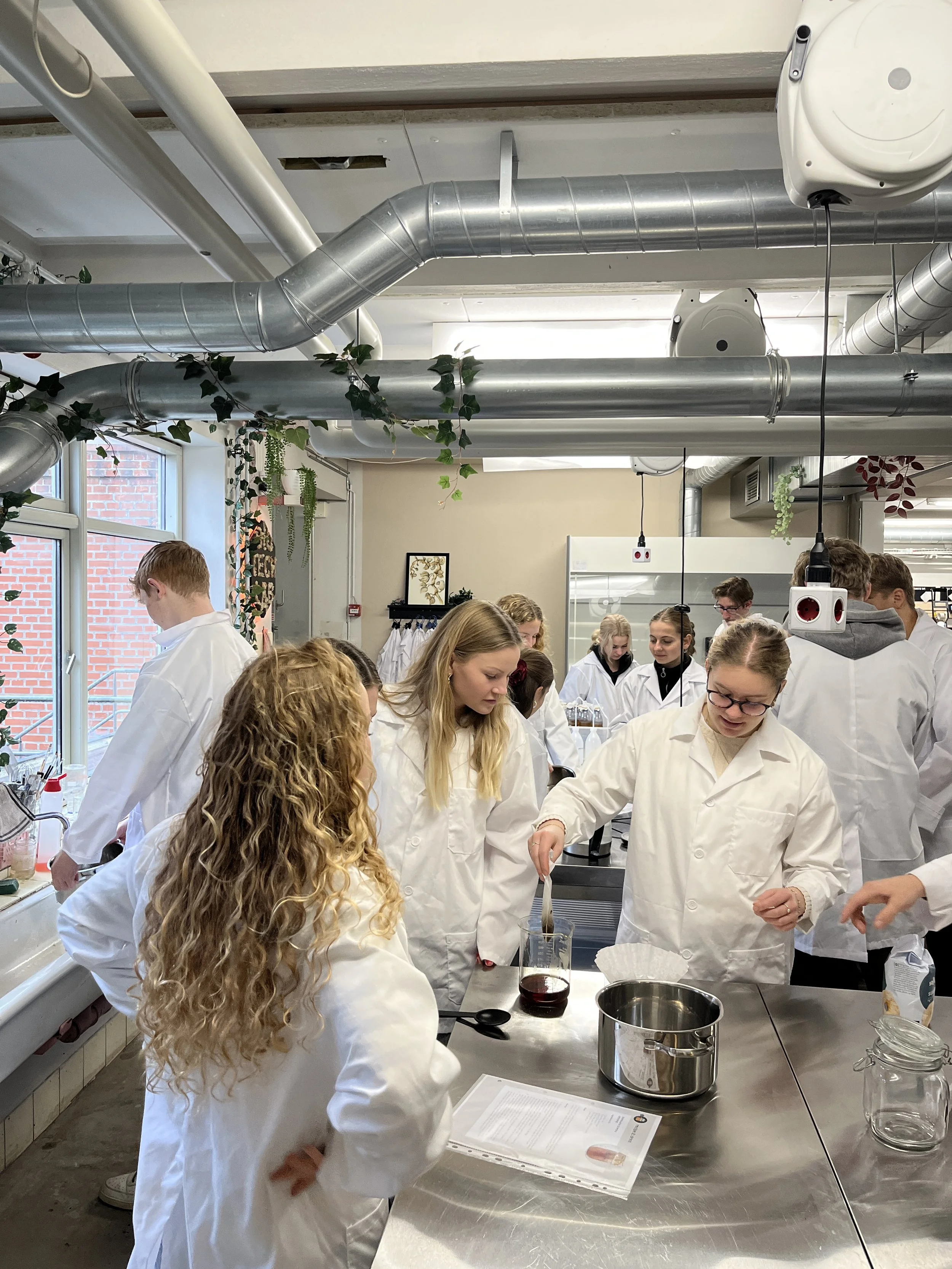
One spring afternoon, six students arrived from the Kolding School of Design. Their professor had sent them because they wanted to work on biodesign projects. The course they were enrolled in—”Material Narratives”—was the same one that had first inspired my passion for biodesign. I could offer them the lab and knowledge that I had wished for back then. Now, one group was working with mycelium; another was experimenting with slime mold; and yet another was attempting to grow garments. When they invited me to their design school exhibition at the end of the semester, a student handed me a strawberry plant, a box of pralines, and a note that read, “Thank you for helping us grow sweet things.”
Toward the end of my contract, I worked 14-hour days tying up loose ends, feeding the garden, logging our activities, making my teaching materials accessible, and organizing the space. I had already been accepted into a materials innovation PhD program in Norway, and I knew the date I would leave for Oslo. I did not mind spending long nights at the lab. It felt like saying goodbye.
And at the same time, as the days ticked down toward my departure, I could feel an unwinding. “Shanice, how many Spirulina tanks can we move outside into the hallway for the summer exhibition?” a colleague asked, already disconnecting one from its air pump.
“Is it necessary to move more than one?” I asked, watching another colleague carry the 3D clay printer outside. “Guys, is this really necessary? You know the algae need air and light, right?” From their unimpressed reactions, I could tell that they didn’t understand. I had not even left yet, and my space was already spinning out of control.
Right now, I am sitting in my PhD lab in Oslo, writing this essay to find out why I still feel so emotional about the lab. I thought it was about entanglements—the ones that nurtured me, and added value to my work, the ones that exhausted me. I thought it was about becoming the lab, while building the lab, about the constant push and pull between me, other people, materials, technologies, knowledge, and about losing what I had built. Since I was a small child, I loved to build things, loved it more than actually playing with the things I had built. I thought that my grief was about losing connection. In part it is. But when I sit in silence, and peel back the emotional layers, I arrive at a different conclusion.
Naturally, I am sad to leave behind something I created. I feel sad to leave all the people that shaped the lab, the community, and the sense of belonging, but at the core, I find guilt. I feel like I let people down, like I did not try hard enough, maybe like I should have stayed. I was overwhelmed, and I ran away. I always run away. No matter where I am or what I am doing. No matter how great it is or how much I care for the people, I start feeling restless. The connections and the work begins to suffocate me.
Once in a while, I scroll through lab updates on Instagram posted by Sanne and the design school students. 3D printing clay. Preparing biodesign exhibitions. Creating molds for mycelium. Everyone is there.
Shanice Otersen
Trained as a fashion designer, Shanice Otersen has developed her practice beyond garments into the exploration of materials. She holds a Masters degree from the Kolding school of Design, and is currently pursuing a PhD at OsloMet where her research focuses on sustainable material innovation. Her work brings together design and biology, investigating how materials can be creatively reimagined for the environment. In 2022, she developed the “BioTechLab” in Vejle, Denmark, a space to share and cultivate interest in biodesign among students and creators. Guided by curiosity, her practice is rooted in experimentation, interdisciplinarity, and the intent to contribute to more sustainable futures.